DLATK
Overview
DLATK (Differential Language Analysis ToolKit) is a Python toolkit for correlating language with outcome variables. Differential Language Analysis (DLA) is its signature method. DLA extracts language features, such as n-grams, from a corpus, then correlates the frequency of each feature with an outcome variable across participants.
We apply DLA to the same synthetic ChatbotLab corpus used in the other tutorials in this section: 19 person-to-AI conversations, each “person” tagged with a PHQ-9 depression score. We correlate single-word frequencies with PHQ-9.
Data Format
DLATK reads from a SQL database. It expects two tables: a message table
(message_id, user_id, message) and an outcome table (user_id,
outcome columns). DLATK defaults to MySQL, but it also supports SQLite, so no
database server is required.
ChatbotLab exports conversation data in this shape already, as a SQLite
database with a msgs table and an outcomes table. We use that export
directly, at conversation_data/dlatk/dlatk.db.
The message table can hold many rows per participant, one per message.
DLATK aggregates across whichever column is passed to -c (its alias is
-g) when it extracts features and runs correlations. Messages do not
need to be combined into one row per participant first.
Setup
pip install dlatk
Extracting Unigram Features
DLATK extracts n-gram features with --add_ngrams. We extract unigrams
only, with -n 1. DLATK’s default is 1- to 3-grams, but with only 19
participants, most 2- and 3-grams occur too rarely to correlate with
anything. Unigrams give more participants a non-zero count per word, which
matters more than usual on a corpus this small:
dlatkInterface.py --db_engine sqlite -d conversation_data/dlatk/dlatk \
  -t msgs -c user_id \
  --add_ngrams -n 1
This creates the feature table feat$1gram$msgs$user_id inside
dlatk.db.
Filtering Rare Features
Drop words used by too few participants, since a word only one person uses cannot be a reliable correlate of anything:
dlatkInterface.py --db_engine sqlite -d conversation_data/dlatk/dlatk \
  -t msgs -c user_id \
  -f 'feat$1gram$msgs$user_id' --feat_occ_filter --set_p_occ 0.05
This keeps 243 distinct unigrams, each used by at least 5% of participants.
Running Differential Language Analysis
Correlate each of the 243 unigrams with PHQ-9:
dlatkInterface.py --db_engine sqlite -d conversation_data/dlatk/dlatk \
  -t msgs -c user_id \
  -f 'feat$1gram$msgs$user_id$0_05' \
  --outcome_table outcomes --outcomes phq9 \
  --group_freq_thresh 50 \
  --correlate --csv --rmatrix --sort --no_correction \
  --output_name conversation_data/dlatk/dla_phq9
By default, DLATK corrects p-values for the number of features tested. With
243 features and 19 participants, that correction leaves nothing
significant. --no_correction turns it off, so the p-values below are
uncorrected. Treat them as exploratory, the same way we treat the z-scores
and SDP scores in the other two tutorials.
Word Clouds
Add --tagcloud --make_wordclouds to the same command to render the
significant words as word clouds, sized by effect size, instead of just
printing the correlation table:
dlatkInterface.py --db_engine sqlite -d conversation_data/dlatk/dlatk \
  -t msgs -c user_id \
  -f 'feat$1gram$msgs$user_id$0_05' \
  --outcome_table outcomes --outcomes phq9 \
  --group_freq_thresh 50 \
  --correlate --csv --rmatrix --sort --no_correction \
  --tagcloud --make_wordclouds \
  --output_name conversation_data/dlatk/dla_phq9
This writes two PNGs to
conversation_data/dlatk/dla_phq9_tagcloud_wordclouds/, one per
direction of the correlation:
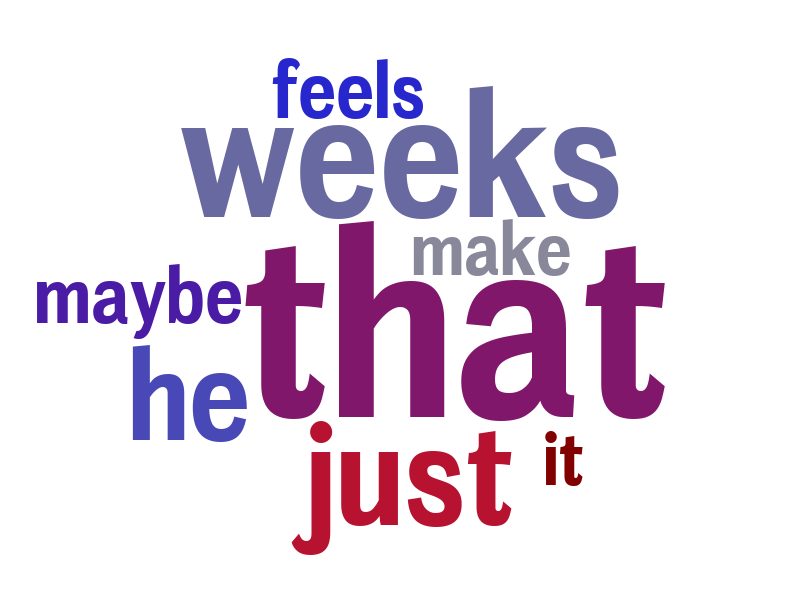
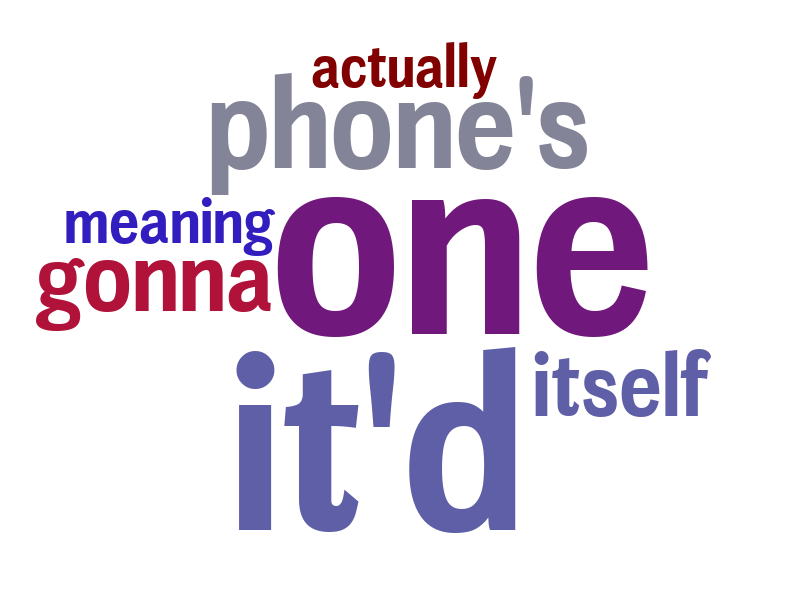
Larger words have a larger absolute correlation with PHQ-9. The left cloud is the same word list as the “higher PHQ-9” table below; the right cloud is the “lower PHQ-9” table.
Results
Words significantly correlated with higher PHQ-9, uncorrected p < .05:
word |
r |
p |
freq |
|---|---|---|---|
that |
0.674 |
.0016 |
51 |
weeks |
0.586 |
.0083 |
7 |
just |
0.583 |
.0088 |
98 |
he |
0.513 |
.0247 |
13 |
maybe |
0.499 |
.0295 |
42 |
feels |
0.497 |
.0303 |
17 |
it |
0.464 |
.0453 |
140 |
make |
0.461 |
.0467 |
6 |
Words significantly correlated with lower PHQ-9:
word |
r |
p |
freq |
|---|---|---|---|
one |
-0.589 |
.0080 |
17 |
it’d |
-0.568 |
.0111 |
4 |
phone’s |
-0.550 |
.0147 |
3 |
gonna |
-0.540 |
.0171 |
20 |
itself |
-0.519 |
.0228 |
4 |
meaning |
-0.510 |
.0256 |
5 |
actually |
-0.503 |
.0281 |
37 |
just and feels correlate with higher PHQ-9 here, the same direction
found by ConvoKit’s Fighting Words and the R text package’s Supervised
Dimension Projection on this corpus. Three different methods point to the
same words.
With only 19 participants and no p-value correction, this is a
demonstration of the workflow, not a finding. Re-run this pipeline on a
properly powered study export, and drop --no_correction.
Generalizing
Swap phq9 for any other column in outcomes.csv, such as age, or a
REDCap or Qualtrics field passed through at
Survey Integration. DLATK also extracts features beyond raw
n-grams, including LIWC categories, LDA topics, and transformer embeddings,
any of which can replace the unigram feature table in the correlation step.